Like most people I have many identifiers. Currently I call myself writer, author, minister of Word and sacrament in the ELCA, and child development specialist. I am also a mother, widow, wife, sister, and daughter. My pronouns are she/hers.
For they all saw him and were terrified. But immediately he spoke to them and said, “Take heart, it is I; do not be afraid. Mark 6:50 NRSV
When it was evening on that day, the first day of the week, and the doors were locked where the disciples were, for fear…Jesus came and stood among them and said, “Peace be with you.”John 20: 19 NRSVUE
Reflection
After the accumulated traumatic experiences leading to Jesus’ death, the disciples felt fear (perhaps not for the first time) for their lives. The cross’ terror pounded through their bodies. Causing them to hide from the world. Live inside locked doors. Stay on guard. Peek out with wary eyes.
Jesus’ voice on the water and again in the locked room consoles the disciples. Settles their activated nervous systems. Gives them a sense of relief. The space within to see and hear what and who is truly there.
These words, “do not be afraid,” may also console us now. Remind us to breathe into our racing thoughts. Breathe into our protruding visions of what happened. The ones breaking into our everyday moments. Victimizing our survivorship. Directing our words and actions. In hurtful ways.
Yet there may be days in which these words, “do not be afraid,” just hurt. Illicit curses like WTF, Jesus! And questions such as how? How can I not be troubled or worried or afraid? Jesus’ words working not as reassurances. But as platitudes. No better than “God has a plan,” or “God doesn’t give us anything we can’t handle.” Making our whole bodies, even our toes shout into our socks and shoes, “bullshit!”
Because we are afraid. Fear both saved our lives and brought us to this place in trauma’s afterlife. Life threatening fear still alive within us. Refusing to be calmed like the water by four words desiring peace for us.
Healing Practice: Take Heart
Breathe into your fearful heart. Just breathe into it. Allow your fears their space in your heart.
Picture yourself on your heart. Breathe into your troubled heart. Breathe deeper and wider.
Picture those who weigh heavy on your heart. Loved ones’ suffering. Joining you on your heart. Breathe into your troubled heart. Breathe deeper and wider.
Expand your breath until it dances with your fearing heart. Its wind weaving in and out of heart’s pumping action.
Keep breathing. Allowing breath’s wind to move with all who are on your heart this day. Allowing your breath to bring all of you together in one big dance.
Prayer
God of troubled hearts, worried heads, and fearful bodies, show us what Jesus meant when he said, “do not be afraid.” For his disciples then. For us now. Help Jesus’ words break into our fear. Bringing us a sense of peace, momentary or otherwise. Amen.
In health and human development we often use this term: survive or thrive. An either/or term with an embedded orbit between the two. Teachers, child development specialists, medical doctors, therapists, chaplains, pastors, loved ones, and really most of us want children and all people to move beyond surviving into thriving. Because surviving can be a time of waiting, frustration, fear, feeling stuck, and powerlessness. We use terms such as survival mode, subsisting, and stagnate to describe the extreme edge of this survival spectrum and softer terms such liminal space and limbo to describe survival as more temporary.
Environmental and systemic circumstances such as racism, genderism, joblessness, poverty, lack of resources, and poor or declining health attempt to hold us in survival. The ongoing worry about safety, food, housing, income, and health overtime can become a traumatic experience adding another layer of pain onto life in survival. Any traumatic experience may also keep us securely in perpetual fight or flight, even freeze states. Surviving then becomes a form of hypervigilant maintenance. Of keeping things as stable as possible while existing always on the edge of the next bad thing happening.
If surviving continues or moves into more security toward or into thriving’s beginnings, trauma’s leftovers from the time of living close to death can create more disease, the autoimmune and inflammatory kind. Disease throws us back into surviving once again shutting down the other end of this trajectory of survive or thrive.
Surviving is not to be minimized. The experience of just surviving seems relentless and unending for most people. Yet self and other compassion asks us to hold gently the miracle of surviving. Our bodies keeping us alive again and again after possible non-survival. Desiring us to move the other way toward and into thriving.
We survive then to thrive. Surviving becomes the living basis in which to add on layers of living. Layers such as growing in deep health, relationships, possibilities, accomplishments, and resources. When we cannot move toward thriving we of course feel stuck because flow is denied.
I, like many people, overuse the word thrive. I want my sons to thrive. I want my new husband to thrive. I want all my beloveds to thrive. I want all of creation to thrive. I want to thrive. The word thrive means “to grow vigorously,” and flourish.* Yet my heart embraces the word flourish as something more than thriving. A word meaning “to grow luxuriantly.”** Flourishing, for me, extends life’s various layers of growth. Creating an out of rather than an or. Instead of survive or thrive, we build: Survive first. Move toward and into thrive leading into a time of flourishing and beyond.
How can we build from surviving? Through healing. Deep, ongoing healing leads us out of surviving, into thriving and toward flourishing. Healing creates goodness within and around. In goodness we are no longer separated from love of self and others. In healing we create more internal and external space to ensure everyone has access to healing.
How do we heal? We begin with the simple desire to heal. Just a tiny mustard seed amount desiring something else. Something replacing the suffering in us and around us with hope. Something washing away the layers of pain bit by bit until we find ourselves where we’ve always existed, encapsulated in love. Love flowing in, above, under, and around us.
Then what do we do? Without thinking we connect and reconnect. Realize we’ve been shut down and away from the world and its people. The process of healing rejoins us to ourselves, others and all that is greater than ourselves–the universe and Spirit. This connection and reconnection, in Scriptural terms, uses the word righteousness or righteous. As in I have reconnected to God. Words which have come to mean, in some traditions, following God’s rules, being obedient to these rules even if they are the rules of powerful humans and not God. For so many people, myself included, these terms feel like more trauma turning my stomach around. I remind myself in healing that there are other understandings of these words.
So, what if we substitute righteousness with healed? Here’s what happens in Psalm 92, verses 12-15 when we do. (NRSVUE)
12 The righteous flourish like the palm tree and grow like a cedar in Lebanon.
The healed flourish like the palm tree and grow like a cedar in Lebanon.
13 They are planted in the house of the Lord; they flourish in the courts of our God.
They are planted in the house of God; they flourish in the places of our God.
14 In old age they still produce fruit; they are always green and full of sap,
In old age the healed still produce fruit; the healed are always green and full of sap,
15 showing that the God is upright; God is my rock, and there is no unrighteousness in God.
showing that God is healed and wants healing; God is my rock, and there is no un-healing in God.
There is no un-healing in God. What a thought! What a belief! God wants us to move beyond surviving. God wants us to heal. God wants us to build on survival into what is possible for ourselves, others, and all creation. And when some of us begin to move out of survival into thriving, God wants us to turn back toward those people still in survival. God wants us to connect, have compassion. Offer healing ways to all people, to all of creation. Only when we heal, connect, and ensure others will also heal can we truly flourish within ourselves and in our world. Flourishing then is an act of compassion for self and others.
I’ve been traveling a lot lately. And in my travels I’ve met many people harmed by some form of Christianity. Some by my own denomination. Yet all the people I’ve met still seek something greater than themselves: The earth, other gods, nature, other ways of believing in something. But God, the God I proclaim, seems absent.
Garden of the Gods, Colorado Springs, Colorado
I too, know this sense of God’s absence. I felt it in the depths of trauma’s aftermath. I feel it now as I write these words. What I’ve learned though is that fatigue, anger, and stress impact my daily sense of God. And experts tell us that the experience of prolonged spiritual absence is a symptom of unhealed trauma. Healing and self-care uncover our innate spiritual selves. Yet not necessarily back to the pews of our past. But back to something–named or unnamed.
God, are you always with us? Even when we cannot feel your presence. See you in nature, animals, other people? Even when we cannot trust you? Or believe in your presence anywhere? Hold us in hope for the return of our spiritual selves. Amen.
If your organization, church, podcast, conference, library, or literary festival is interested in inviting me to speak, preach, or lead a workshop, please click here: Invite Jennifer to Speak.
BONUS SECTION
From an early draft of my book.
The minute I laid down I knew something was wrong
For days I felt tired. Tired to the bone. Slogging through my days. Achy as if coming down with something.
School was in session. Is Paul bringing home the latest bug?
Sure, I was working out more if only to save my skeleton. But my new regime began weeks ago. Really! My body should be used to all these weights and prolonged walks by now!
Yes, I was writing all the time. For work. For me. For seminary. Lower arms feeling a bit stiff at the end of each day. But that’s to be expected, isn’t it?
But I also felt edgy. Tense. So tense I couldn’t break out of it no matter what I did. Then I started having headaches. Really bad headaches accompanied by nausea. Happened at church one Sunday morning. Left worship to ask around for some acetaminophen. “What’s wrong?” a friend wondered.
“I’ve been reading the Old Testament book of Amos all morning for seminary. I think I have Amos head.”
“Well, I’m glad we have a name for it,” she replied.
At noon I laid down to nap. Too tired to go on. Study more. Write more. Take care of more bills, schedule more appointments, wash more dishes, do more laundry.
In bed my body spoke to me. Nervousness rushed everywhere within me. Agitation kept me from stillness. Even though this felt different, I breathed like I would in an anxiety attack. Long deep breaths in through my nose. Blown out through my mouth in steady pulses. Rhythm bringing in hope. Pushing out pain.
It worked, sort of. But not completely.
So, I waited. Breathing taking the edge off for a time. Never forever. Forever requiring deep healing for this stuff to cease residing in my body, any body. Is this a relapse? Or is it the next layer of pain ready for healing?
Checked my calendar. Another EMDR session in a few days. Healers and healing on their way.
THE VALUE OF NEWSLETTERS & REVIEWS
Being an author, especially a spiritual author, means also being my own marketing director. And I admit I have all sorts of feelings about being tied to the social media self-promotion cycle. Yet there has always been a business side to writing. So here’s what publishers, book sellers, and writers know about getting books into readers hands, eyes, and hearts:
NEWSLETTERS: The more people on an author’s newsletter email list, the more the author sells their books. You can be on my newsletter list by simply following my blog. To do so, press the SUBSCRIBE button on the upper left side of this page.
REVIEWS: The more online reviews a book receives, the more a book sells. Please consider reviewing my book on Goodreads and at my Amazon author’s page.
Thank you!
WHAT I AM READING
I’ve never been much of a fan of Cognitive Behavioral Therapy (CBT) person. Tony, my late husband and trauma therapist, was not either. We both felt professionally that its effects were not long term nor reached for root causes. When it comes to trauma recovery, many of the primary researchers agree. Why? Because CBT is about the mind, not the body. And trauma infects our entire selves. Yes, I use some CBT methods at times but as an adjunctive method and not for my deep, long lasting healing needs.
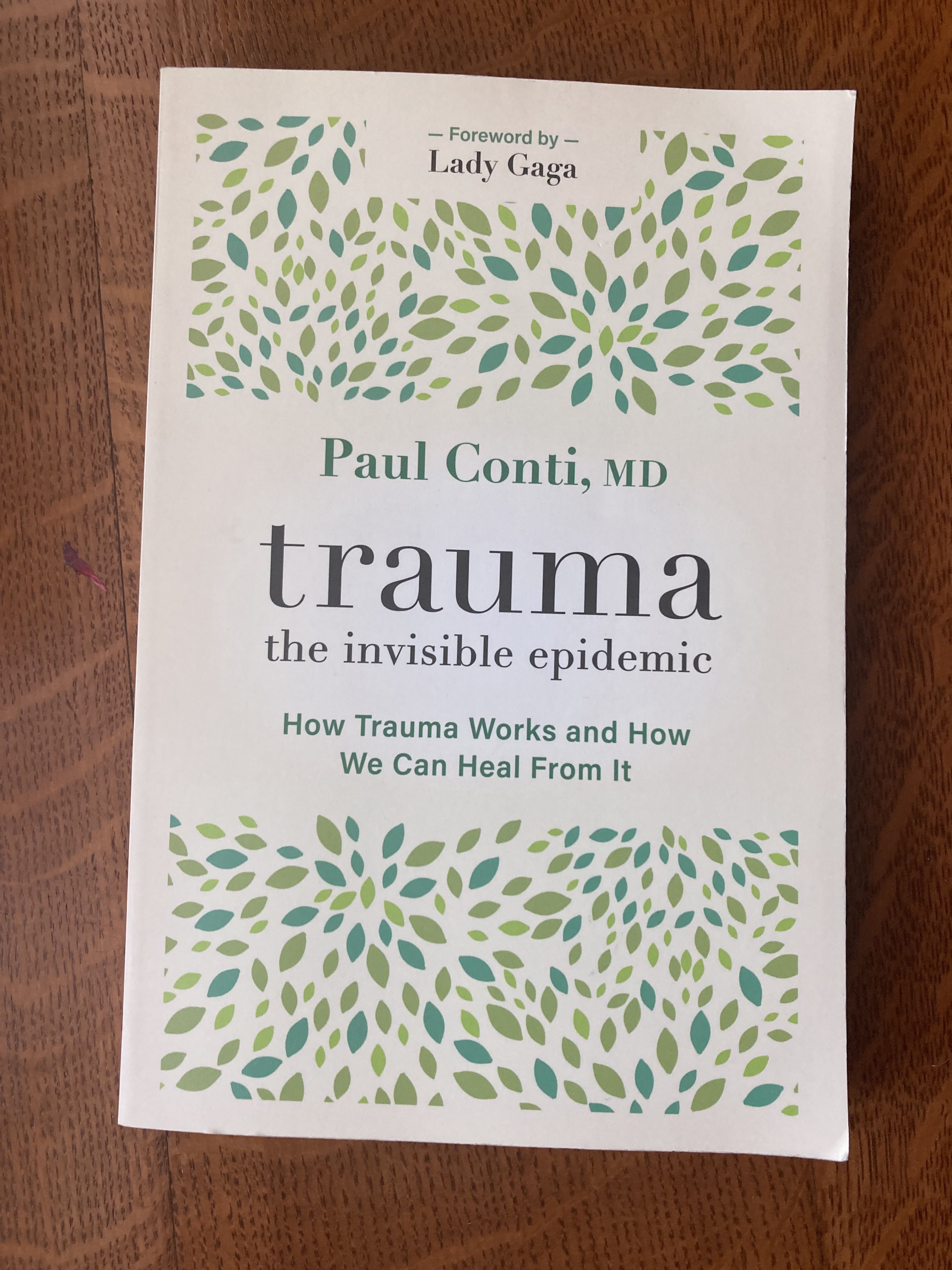
Medical doctor and author Paul Conti agrees. He writes, “The idea that we can simply get over difficult things that happened to us in the past is far more common than it should be, and in my opinion, some cognitive-behavioral therapy techniques (CBT) perpetuate this notion.” (71)
Read his book for an insider view of how the medical treatment of trauma often goes wrong.
September Newsletter, 2022: All rights reserved by the author.
Day after day friends and family post photos. Captured images of beloveds in various stages of growing. Openly signified by first day photos–first day of kindergarten, first day of high school, first day at college, first day of new job.
Smiling faces drift past me on our way to more immediate needs: Traversing an unknown community. Foraging for housing in an insane rental market. Assisting my beloved son in his move into life at a major university three states away.
Outside lens of our timing imprudent, illogical, poorly planned. Lagging behind typical preparation for such moves. Yet everything in our reality these past seven years holds an alternative beat. Our truth, and that of so many others like us, a fierce accuracy of life’s veritas catching our family’s soul in knotted twine.
This current shift for us, son from family home to college, includes messaging a hundred or so people about sublets or rooms. Negotiating congested roads full of large cars pulling rental trailers. Shopping emptied shelves for necessary, forgotten items,. Dispersing last minute warnings and advice, laughing, talking, sharing truths, and one or two small meltdowns.
Each task, each moment woven with threads of what it took for us to be here. Until we realize we’ve been wandering in this coveted dessert for nine days. Culminating on day ten with a longer than usual hug and the closure words needing voicing so the next can begin.
“Goodbye, I love you.”
Publicly proclaimed in a parking lot on the edge of campus. Large brown eyes staring down at me from above for a mutually held second. Before turning, hitching up his backpack, and walking away.
From me.
As my heart, joy, hope, sacrifice, and one of two reasons for doing healings’ work distances himself. Head held high. Facing another unknown, this time without me. Without his brother. Once again without his father.
Morning, misting eyes witnessing. Silent voice embracing courage–his, mine. Body ready to follow in an act of beholding.
Instead standing, still.
Watching as the one who grew the beginnings of this young man in my soul. Bore him one Winter’s night. Raised him with Tony, then alone. Now experiencing this supposed typical moment. Heart filling with sadness, balm, and gratitude. As I leave. Tears flowing. Knowing I am now closer to my own death than to his. Which is a gift in and of itself.
Two seminary professors asked my classmates and me this question:
“What is Gospel?”
What? Aren’t we supposed to know what Gospel is? Isn’t part of being a Christian knowing this stuff. Even if we are sort of a part-time Christian? Or even a couple-times-a-year Christian?
Oh Crap. I’m in seminary and I’m Googling the definition. If anyone is supposed to know what the Gospel is, it’s people like me.
Google is good though. I get “the revelation of Christ.”
Revelation, now that’s an interesting word. It’s from the verb, to reveal. Reveal meaning make known, disclose, tell, release. So are the Gospels like God’s version of reality TV’s “big reveal?” Like God’s big makeover? God not happy with God’s image or God’s house? Or both? Or is this revelation something else?
I’m banking on a combination of all of the above. Beginning with Old Testament metaphors. Words used to describe God by comparing God to other stuff like king, father, ruler, rock, fire, water, tree, potter, beekeeper, shepherd, stronghold, fortress, and high ridge. God, according to these comparisons, is a leader, a collection of necessary natural resources, a creator of earthly goods, a farmer, and a protector. All image with some relationship stuff.
The Old Testament also speaks of a savior. Someone or something being sent by God some time in the future. This savior also has many names. Names such as branch, son, gift, prince of peace, counsellor, signal, and Immanuel.
Immanuel, a different word than the rest. A name rather than a metaphor. A word meaning God with us. But how? How is God with us?
Back to the metaphors. God has been with God’s people from the beginning. In a variety of odd ways. God the seamstress made clothing for Adam and Eve as they left the garden. God the burning bush got Moses’ attention. God the natural resource produced water from desert rocks for thirsty Israelites. In the Old Testament God shows up story after story sticking with people. Regardless of their actions. Regardless of their doubts. Regardless of their complaining.
And then comes the New Testament. Beginning with the books of Matthew, Mark, Luke, John. Four books called “the Gospels.” Four books about Jesus’ life on earth including his death and it’s afterwards. Stories revealing who this guy was and is. And because Jesus is both fully human and fully divine, these same books reveal who God is as well.
So what do we find out about Jesus and God in the Gospel stories? What is revealed? Uncovered? Made clear? Discovered?
In Immanuel, God is made known in a new way. A more intimate way. Immanuel God is God of the burning bush and the whirlwind and the shouting prophet and a collection of odd metaphors and something more.
In the beginning was the Word, and the Word was with God, and the Word was God. He was in the beginning with God. All things came into being through him, and without him not one thing came into being. What came into being in him was life, and the life was the light of all people. The light shines in the darkness, and the darkness did not overcome it.
Words from the beginning of the fourth Gospel, the Gospel of John. Jesus, the Word, the message, the light, the past, current, and ongoing story. Jesus, both with God and with us as well. Humans depicted as the metaphor of darkness in contrast to the metaphor used for God, light. Humans never God or able to overcome God even though we try obliterating our own humanness and all of creation instead. Reading verse 5 as: “God loves into our humanness, and our humanness did not succeed in overcoming God.”
In the beginning was the Word creating life, everlasting and continuing life. Life-giving life for all people, all creation. Our life always with God and God always with us. Where ever we are. In suffering. In joy. In sorrow. In hope. Sometimes in crazy talking burning bushes. Sometimes in the skilled hands of a surgeon. Sometimes in the embrace of a friend. Sometimes in a smile from a stranger. Sometimes in a wrong that has been made right. Sometimes when we reach out to help someone else.
God with us, in us, loving us, always. Love, a gift. Called grace. For everyone. Grace given when we try to cover up God. Grace given when we stop and see a glimpse of God instead. Grace, relational, forgiving, feeding, caring, repairing. Grace calling us to do God’s work on earth as it is in heaven.
The Word, a metaphor. Containing enormous meaning. Word as message, story. In the beginning was and is our never-ending story of being human. Of being God’s beloved people and of who God is. God known to us, not only in a collection of words. But God as human being. In Jesus Christ. Jesus, “the word of life…revealed.” (1 John 1: 2) Always with us through Spirit’s breath, wind, energy, and call. God, Immanuel still. Then. Now, Tomorrow. Always.