Like most people I have many identifiers. Currently I call myself writer, author, minister of Word and sacrament in the ELCA, and child development specialist. I am also a mother, widow, wife, sister, and daughter. My pronouns are she/hers.
Day after day friends and family post photos. Captured images of beloveds in various stages of growing. Openly signified by first day photos–first day of kindergarten, first day of high school, first day at college, first day of new job.
Smiling faces drift past me on our way to more immediate needs: Traversing an unknown community. Foraging for housing in an insane rental market. Assisting my beloved son in his move into life at a major university three states away.
Outside lens of our timing imprudent, illogical, poorly planned. Lagging behind typical preparation for such moves. Yet everything in our reality these past seven years holds an alternative beat. Our truth, and that of so many others like us, a fierce accuracy of life’s veritas catching our family’s soul in knotted twine.
This current shift for us, son from family home to college, includes messaging a hundred or so people about sublets or rooms. Negotiating congested roads full of large cars pulling rental trailers. Shopping emptied shelves for necessary, forgotten items,. Dispersing last minute warnings and advice, laughing, talking, sharing truths, and one or two small meltdowns.
Each task, each moment woven with threads of what it took for us to be here. Until we realize we’ve been wandering in this coveted dessert for nine days. Culminating on day ten with a longer than usual hug and the closure words needing voicing so the next can begin.
“Goodbye, I love you.”
Publicly proclaimed in a parking lot on the edge of campus. Large brown eyes staring down at me from above for a mutually held second. Before turning, hitching up his backpack, and walking away.
From me.
As my heart, joy, hope, sacrifice, and one of two reasons for doing healings’ work distances himself. Head held high. Facing another unknown, this time without me. Without his brother. Once again without his father.
Morning, misting eyes witnessing. Silent voice embracing courage–his, mine. Body ready to follow in an act of beholding.
Instead standing, still.
Watching as the one who grew the beginnings of this young man in my soul. Bore him one Winter’s night. Raised him with Tony, then alone. Now experiencing this supposed typical moment. Heart filling with sadness, balm, and gratitude. As I leave. Tears flowing. Knowing I am now closer to my own death than to his. Which is a gift in and of itself.
Two seminary professors asked my classmates and me this question:
“What is Gospel?”
What? Aren’t we supposed to know what Gospel is? Isn’t part of being a Christian knowing this stuff. Even if we are sort of a part-time Christian? Or even a couple-times-a-year Christian?
Oh Crap. I’m in seminary and I’m Googling the definition. If anyone is supposed to know what the Gospel is, it’s people like me.
Google is good though. I get “the revelation of Christ.”
Revelation, now that’s an interesting word. It’s from the verb, to reveal. Reveal meaning make known, disclose, tell, release. So are the Gospels like God’s version of reality TV’s “big reveal?” Like God’s big makeover? God not happy with God’s image or God’s house? Or both? Or is this revelation something else?
I’m banking on a combination of all of the above. Beginning with Old Testament metaphors. Words used to describe God by comparing God to other stuff like king, father, ruler, rock, fire, water, tree, potter, beekeeper, shepherd, stronghold, fortress, and high ridge. God, according to these comparisons, is a leader, a collection of necessary natural resources, a creator of earthly goods, a farmer, and a protector. All image with some relationship stuff.
The Old Testament also speaks of a savior. Someone or something being sent by God some time in the future. This savior also has many names. Names such as branch, son, gift, prince of peace, counsellor, signal, and Immanuel.
Immanuel, a different word than the rest. A name rather than a metaphor. A word meaning God with us. But how? How is God with us?
Back to the metaphors. God has been with God’s people from the beginning. In a variety of odd ways. God the seamstress made clothing for Adam and Eve as they left the garden. God the burning bush got Moses’ attention. God the natural resource produced water from desert rocks for thirsty Israelites. In the Old Testament God shows up story after story sticking with people. Regardless of their actions. Regardless of their doubts. Regardless of their complaining.
And then comes the New Testament. Beginning with the books of Matthew, Mark, Luke, John. Four books called “the Gospels.” Four books about Jesus’ life on earth including his death and it’s afterwards. Stories revealing who this guy was and is. And because Jesus is both fully human and fully divine, these same books reveal who God is as well.
So what do we find out about Jesus and God in the Gospel stories? What is revealed? Uncovered? Made clear? Discovered?
In Immanuel, God is made known in a new way. A more intimate way. Immanuel God is God of the burning bush and the whirlwind and the shouting prophet and a collection of odd metaphors and something more.
In the beginning was the Word, and the Word was with God, and the Word was God. He was in the beginning with God. All things came into being through him, and without him not one thing came into being. What came into being in him was life, and the life was the light of all people. The light shines in the darkness, and the darkness did not overcome it.
Words from the beginning of the fourth Gospel, the Gospel of John. Jesus, the Word, the message, the light, the past, current, and ongoing story. Jesus, both with God and with us as well. Humans depicted as the metaphor of darkness in contrast to the metaphor used for God, light. Humans never God or able to overcome God even though we try obliterating our own humanness and all of creation instead. Reading verse 5 as: “God loves into our humanness, and our humanness did not succeed in overcoming God.”
In the beginning was the Word creating life, everlasting and continuing life. Life-giving life for all people, all creation. Our life always with God and God always with us. Where ever we are. In suffering. In joy. In sorrow. In hope. Sometimes in crazy talking burning bushes. Sometimes in the skilled hands of a surgeon. Sometimes in the embrace of a friend. Sometimes in a smile from a stranger. Sometimes in a wrong that has been made right. Sometimes when we reach out to help someone else.
God with us, in us, loving us, always. Love, a gift. Called grace. For everyone. Grace given when we try to cover up God. Grace given when we stop and see a glimpse of God instead. Grace, relational, forgiving, feeding, caring, repairing. Grace calling us to do God’s work on earth as it is in heaven.
The Word, a metaphor. Containing enormous meaning. Word as message, story. In the beginning was and is our never-ending story of being human. Of being God’s beloved people and of who God is. God known to us, not only in a collection of words. But God as human being. In Jesus Christ. Jesus, “the word of life…revealed.” (1 John 1: 2) Always with us through Spirit’s breath, wind, energy, and call. God, Immanuel still. Then. Now, Tomorrow. Always.
Clipping along at 70 miles per hour, maybe faster. Mile after mile bringing me closer to what I have dreaded for almost six years. My stomach tells me we are almost there. Thankful Forrest drives, not me.
Phone rings. Answer only because it’s one of my sons, Ricardo. With a question. We’ve all just moved. Our lives, in boxes, transitions, and unknowns. We talk briefly, say “goodbye,” and “I love you.”
Realize the moment of trepidation, crossing the Illinois state line into Wisconsin for the first time since Tony died, flew by five miles or so ago.
Instead in that second, the passage between states, my eyes focused on us. The here and now in our relationship as son and mother. The universe aligned with synchronicity acknowledging our truth, both living and dead, in protective action.
If your organization, church, podcast, conference, library, or literary festival is interested in inviting me to speak, preach, or lead a workshop, please click here: Invite Jennifer to Speak.
THE VALUE OF NEWSLETTERS & REVIEWS
Being an author, especially a spiritual author, means also being my own marketing director. And I admit I have all sorts of feelings about being tied to the social media self-promotion cycle. Yet there has always been a business side to writing. So here’s what publishers, book sellers, and writers know about getting books into readers hands, eyes, and hearts:
NEWSLETTERS: The more people on an author’s newsletter email list, the more the author sells their books. You can be on my newsletter list by simply following my blog. To do so, press the SUBSCRIBE button on the upper left side of this page.
REVIEWS: The more online reviews a book receives, the more a book sells. Please consider reviewing my book on Goodreads and at my Amazon author’s page.
Thank you!
WHAT I’M READING
I love non-fiction books and not just ones about theology, pastoral care, or trauma recovery! I also love reading travel books which fill me with dreams of future trips. Last month, while selling books to a local used book store, I fell in love with the cover of a book. I didn’t buy it because I promised myself I would not buy any more books until after our move. But then we went back with another trunk load of books to sell and… I just had to buy it! So if you love the combination of books, travel, and Iceland, check this one out.
August Newsletter, 2022: All rights reserved by the author.
My late husband, Tony, was a licensed clinical social worker. He specialized in two specific areas of trauma recovery—sexual addictions and male survivors of childhood sexual violence including clergy abuse. Often Tony came home with this complaint:
“I had another new client today who went to his pastor first. His pastor was shaming. Had no compassion. Now my client’s healing will be longer and my job, harder.”
Tony died, suddenly. Tragically. Too soon. After he died, I went to therapy twice a week. I had to. The traumatic events which took Tony’s life, almost took our sons’ lives, and threatened mine. Therapy was a way to survive. To be here for our sons. To make sure we all made it through this mess of leftovers. In our afterwards, I often wondered aloud to my therapists about the pastor’s role in recovering from traumatic experience. They too expressed frustration at the often uninformed and harmful behavior of clergy toward people living in trauma’s pain.
In Seminary
Then I began seminary to become a pastor. Because I was enrolled to do so before Tony died. And now I just needed something to focus on other than tracking the trauma recovery progress of the three of us. But I was never fully there in seminary. Just present enough to learn a little bit more about God, myself, others, make a few friends, earn a degree.
In my first pastoral care class I disagreed with the guest speaker, a psychologist, on whether or not Eye Movement Desensitization and Reprocessing (EMDR) is exposure therapy or not (it’s not!). My protest led to a realization: I wanted to remember Tony’s legacy by not becoming one of those pastors he complained of. The ones screwing it up for the suffering person, their loved ones, and their therapist. So, I took far more than the required number of pastoral care courses, read Tony’s professional library until I ran out of books, began buying my own books on trauma recovery, wrote about it, and continued my own healing through various forms of therapy.
Now graduated I still spend a lot of time reading about trauma recovery, studying the experts, and taking online courses so that I can write and speak into the sometimes- murky intersection of trauma recovery and our faith as Christians. In doing so, memories resurface.
Earlier,Before Tony
While living in New York City as a young singer and actress, I haunted the self-help and psychology sections of bookstores so much so that a friend commented, “You are always looking at these books!”
Instead of waiting table like many want-a-be creatives, I facilitated parent and young child play classes. I became fascinated by how young children grow and learn so I enrolled in a child development degree program. The works of Erik Erikson, Alison Gopnick, Jean Piaget, Margaret Ainsworth, Lev Vygotsky, Stanley Greenspan, and a host of others opened new ways of viewing myself, others, and our relationships.
Student teaching in an urban poor and violent neighborhood increased my sense of this country’s true trauma reality. Graduate school textbook examples became human revelations of deep suffering: Families attempting survival in violent neighborhoods, the propensity of food scarcity especially healthy food in areas experiencing poverty, sexual abuse statistics far greater than reported, normalization of domestic violence, and historic, generational, and ongoing disparities based on race, gender, and ethnicity.
Empathy filled my body each day with pain making me flee from our collective truth for a school serving the affluent and white. But seeing my first mother pick up her child from school with bruises on her face was in an affluent school. As was meeting a mother who lost custody of her child due to drug addiction. As was having to call the police when a mother showed up drunk wanting to drive her child home.
These families, while in deep pain, had the means and availability to access healing resources. So, it was in neighborhoods of ongoing poverty that I witnessed the acute, perpetuated after-effects of traumatic experiences. Children trying to touch me in private places. Fathers shot in the head or in prison leaving their children sobbing in our arms. Gangs threatening staff who arranged for mothers to disappear into domestic violence shelters. Young children, gone mute. Small ones fed coffee for breakfast at the end of each month.
In 1994 I left a school serving those who had more than enough to begin teaching in a Head Start preschool in the Chicago neighborhood located at 63rd Street and Kedzie Avenue. Yes, it is here that I met Tony. But it is also here that I worked with a little girl who sat in her cubby all day saying, “I want to go home. I am worried about my mama.”
And another child who spoke and cried in a stuck, high pitched voice while repeating her compressed daily rerun of three Child’s Play horror films.
Still another child, cradling a doll in one arm while holding her stomach with the other, whimpered, “My stomach hurts. My boyfriend punched me. I need an ambulance.”
All three young girls exhibited signs of post-traumatic stress. But in 1994 the best we could do as teachers for children under the age of five was to place them on the long waiting list for psychological evaluations that in our experience might not happen. In the meantime, we attempted remaining internally calm even though witnessing these behaviors was both disturbing to watch and unnerving to listen to. We also built relationships with each child, remained curious about their ongoing behaviors, and tried to practice compassion. Sometimes we succeeded. Often, we failed.
No one talked about self-care or secondary trauma in the 1990’s. I burned out. Moved out of the classroom into directing programs, teaching teachers, and consulting. Yet in quiet moments I still thought and read about trauma symptoms in young children. I was pregnant with my second child and reading a stack of such books when the events of 9-11-01 shifted the world.
Now
This August will be six years. Six years from that clear, summer’s day stabbing me with trauma’s reality and afterlife. Six years of hard work in trauma recovery, healing, and recreating our lives.
My wonderings and writing remain focused on trauma recovery. But my thinking also expands into something perhaps more basic, more theological, even foundational: How does faith in a loving, merciful God intersect with recovery from traumatic events?
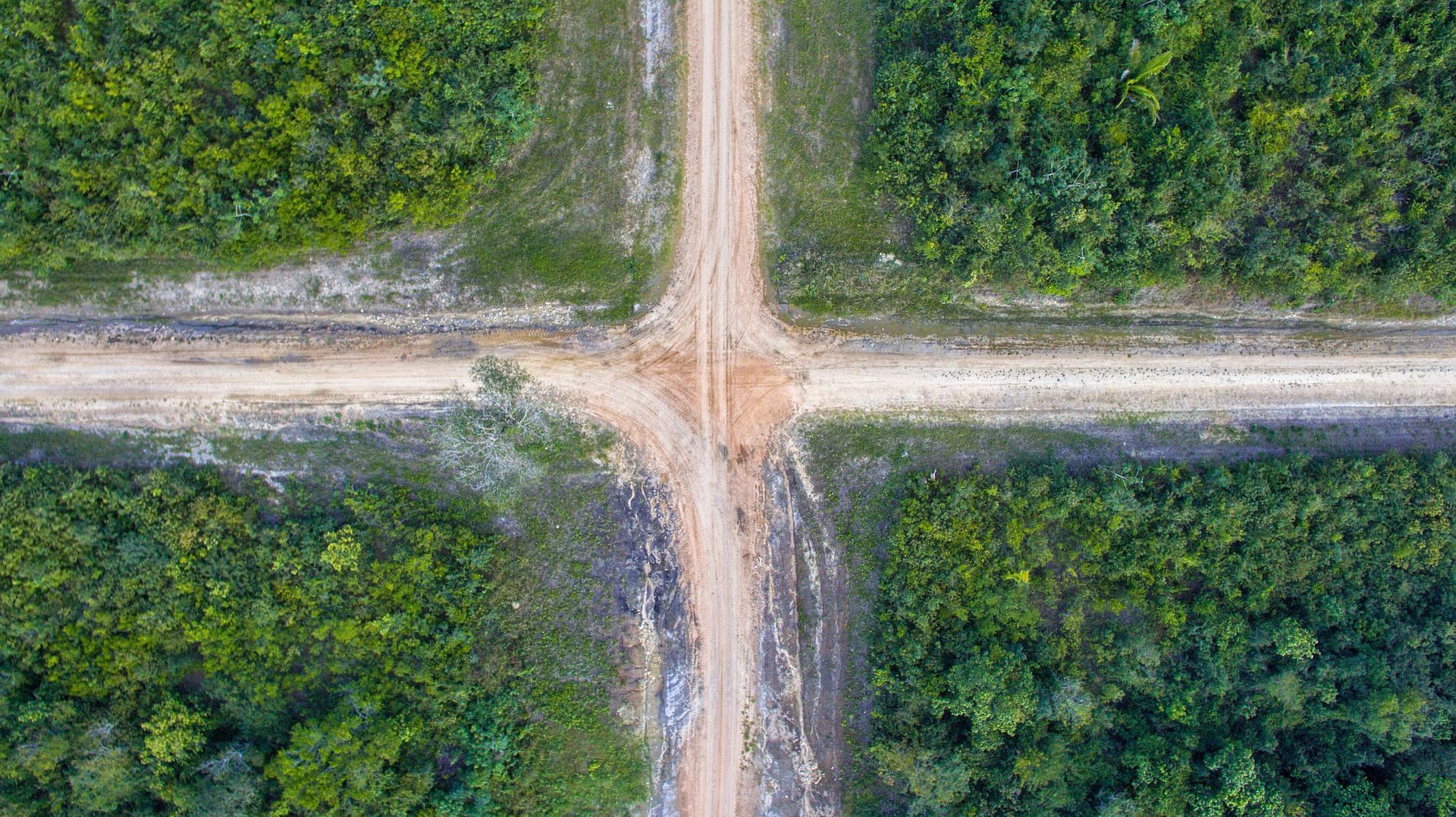
Questions lead me into metaphor. This one, a joining, two lines touching. Connecting at a perpendicular point to a become something–an intersection, a stopping point. A place for four directional choices, a crossroads. A letter used sparingly in the English language named “x.” A shape called cross as in stich, bar, or the leftover symbol of torture and murder attempted on God by humans.
Yet if the two lines have depth, like that of two felled trees, they double at the point of connection. If hollow out, this crossing place forms a pit. The pit, as in the space we all visit, even stay for a length of time, perhaps are still living in. It’s the point we occupy in the afterwards of traumatic experiences. Full of wounds, suffering, despair, and shock.
Pit forms a container for what has happened to us. Holds us until shock subsides. Enough for us to make choices: Either allow traumatic experiences to govern us by choosing to stay in pit not healing. Spread the pain of our traumatic experiences onto ourselves and others. Or the choice to reveal our truth, begin healing, do the work.
The choice to heal reminds me that God’s death on this wood, either in belief or as allegory, was temporary. God rose again. Lived on earth for a time. Once again feeding, teaching, and healing. Before commissioning the disciples to continue the work of “doing likewise.” Assured of and accompanied by God’s ongoing presence through God’s Spirit. Never alone as how it felt during the three days.
Another Memory
One morning, early in our relationship, Tony walked me to my car. The Chicago intersection at Glenwood and Berwyn was under construction. Each day a larger, messier, muddier hole deepened at the center of these crossing streets. We wondered again and again what this work meant? Was the city working on the sewer lines? Or something else? No one seemed to know so we watched, waited. Until one morning we walked out to a new sight. The back end of a car stuck straight up and out while the front end dove deep into the hole like a duck fishing in a pond. We groaned knowing we too had come close to driving into this new pit. Laughed as we imagined the driver opening the door, wondering how to jump down.
By evening the car was gone but we continued talking about the car in the hole outside our door. About a week later workers filled in this pit with a mound of rich black dirt. Then they planted a tree, some bushes, and flowers. The messiness of the pit reformed becoming both a place of beauty and growth as well as a reminder for drivers to slow down, keep safe, keep others safe.
Choice shapes our lives. The choice to heal forms in us in compassion for self toward a new direction. Healing helps us leave the pit knowing it has done its work. Gives us the inner strength and courage to roll our own stones away. Step out of God’s three days with the dead into life afterwards. In the choice to heal we enter new life for ourselves, others, and all of creation.
Hypervigilance. Stuck on high alert. A symptom of unhealed traumatic experience. Leading to constant control of environment, self, and others. Seen in perpetrators of domestic violence, sexual violence, and organizations, governments, and families who follow intense sets of rules. What if those who are trapped by their internal demand for control healed instead?
TRANSITIONS
The last days of June urge us into July. A month when after eleven years in our home we pack our belongings, load a large truck, and transport all that we have across town into a temporary living space. In 2011 we moved to this area full of hope. In July we don’t leave this house in despair. But we do acknowledge all that happened to us as a family, individuals, the country, and world while living in this place called home. We also leave not knowing the future. Because my call into ministry moves painfully slow. And because the world shifted while we lived here in this place. Some shifts make us more truthful. Some shifts tore our hearts open. Some shifts are still healing.
So, we leave. Not feeling metaphorical or poetic. More practical and realistic. Turning faces toward this thing called now and another thing named future. Praying for soft landing at the other end. Knowing life, in its mixture of joy, pain, and sorrow, still claims its essence as worth living.
Behind the scenes for Faith+Lead’s Book Hub event.
RECENT & UPCOMING HAPPENINGS
Article: “Where Faith and Trauma Recovery Meet,” at Bearings Online.
July 16: “Beyond Talking About Trauma.” Wild Goose Festival in Union Grove, North Carolina.
July 30/31: Reading, Q&A, & Book Signing at St. John Lutheran Church in Rock Island, Illinois. Stay tuned for more details!
July 31: Preaching at St. John Lutheran Church in Rock Island, Illinois.
August 6-7: Preaching at Faith Lutheran Church in Eldridge, Iowa.
August 11-12: “Trauma Informed Ministry.” Door County, Wisconsin
September 1 @ 6:30 PM: Book Reading at Beaverdale Books, Des Moines, Iowa.
October 22: “Trauma Informed Liturgy,” with Faith+Lead.
INVITE JENNIFER TO SPEAK
If your organization, church, podcast, conference, library, or literary festival is interested in inviting me to speak, preach, or lead a workshop, please click here: Invite Jennifer to Speak.
THE VALUE OF REVIEWS
Whether we like it or not, there is a business to writing. Every author relies on readers to write online reviews. Please, please, please consider reviewing my book on Goodreads and at my Amazon author’s page. You have my gratitude!
WHAT I’M READING
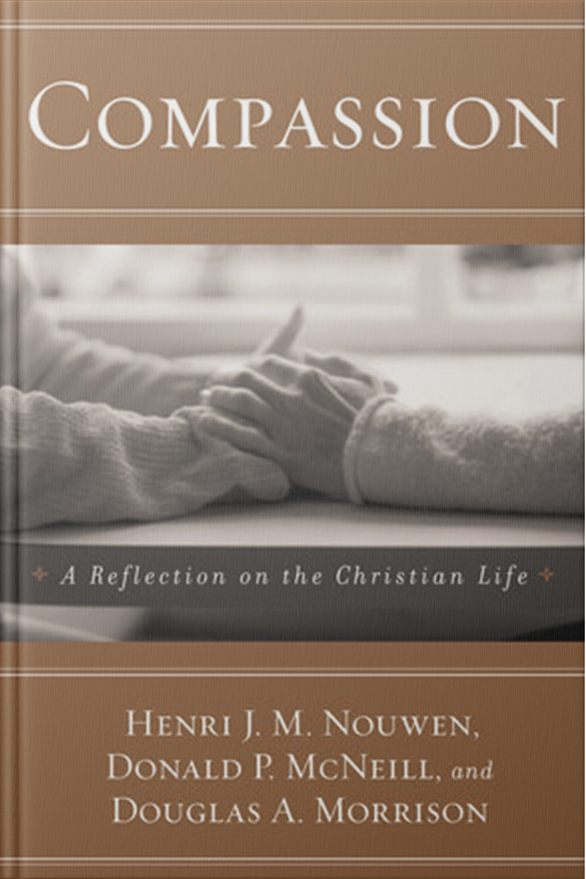
I’ve studied compassion from the clinical researcher point of view and also some of the Buddhist practices of compassion. Now I’m diving into the compassion of Jesus.
BUY MY BOOK
Put A Time to Mourn & a Time to Dance on your bookshelf! My book is currently available (on sale!) at Chalice Press. Also available at Prairie Lights, Barnes & Noble, Coralville, Iowa, Barnes & Noble Online, Books-a-Million, Target, Bookshop.org, and Amazon.
BONUS SECTION
From my journal…
June 2, 2017. Iowa City, Iowa
On a clear day in late spring when the air cleared of Iowa humidity and big white clouds hung in a seemingly simple blue sky, on a day when grief’s pain hit me again and again, I sit in the living room of an senior living apartment listening to a man in his late eighties tell me the adventures of his life. As he does, thought fills my brain. What will I write about once grief is no longer the subject of my morning outpouring of words?
On this day, and I tell the man’s wife so, I think maybe I will write other people’s stories or maybe stories of being a pastor. Because on this clear day, I once again love hearing someone else’s story. Or perhaps I tire of my own. Acceptance of which sprouts in my soul.
JUNE/JULY Newsletter, 2022: All rights reserved by the author.






 Put A Time to Mourn & a Time to Dance on your bookshelf! My book is currently available (on sale!) at
 Jennifer Ohman-Rodriguez