
My late husband, Tony, was a licensed clinical social worker. He specialized in two specific areas of trauma recovery—sexual addictions and male survivors of childhood sexual violence including clergy abuse. Often Tony came home with this complaint:
“I had another new client today who went to his pastor first. His pastor was shaming. Had no compassion. Now my client’s healing will be longer and my job, harder.”
Tony died, suddenly. Tragically. Too soon. After he died, I went to therapy twice a week. I had to. The traumatic events which took Tony’s life, almost took our sons’ lives, and threatened mine. Therapy was a way to survive. To be here for our sons. To make sure we all made it through this mess of leftovers. In our afterwards, I often wondered aloud to my therapists about the pastor’s role in recovering from traumatic experience. They too expressed frustration at the often uninformed and harmful behavior of clergy toward people living in trauma’s pain.
In Seminary
Then I began seminary to become a pastor. Because I was enrolled to do so before Tony died. And now I just needed something to focus on other than tracking the trauma recovery progress of the three of us. But I was never fully there in seminary. Just present enough to learn a little bit more about God, myself, others, make a few friends, earn a degree.
In my first pastoral care class I disagreed with the guest speaker, a psychologist, on whether or not Eye Movement Desensitization and Reprocessing (EMDR) is exposure therapy or not (it’s not!). My protest led to a realization: I wanted to remember Tony’s legacy by not becoming one of those pastors he complained of. The ones screwing it up for the suffering person, their loved ones, and their therapist. So, I took far more than the required number of pastoral care courses, read Tony’s professional library until I ran out of books, began buying my own books on trauma recovery, wrote about it, and continued my own healing through various forms of therapy.
Now graduated I still spend a lot of time reading about trauma recovery, studying the experts, and taking online courses so that I can write and speak into the sometimes- murky intersection of trauma recovery and our faith as Christians. In doing so, memories resurface.
Earlier, Before Tony
While living in New York City as a young singer and actress, I haunted the self-help and psychology sections of bookstores so much so that a friend commented, “You are always looking at these books!”
Instead of waiting table like many want-a-be creatives, I facilitated parent and young child play classes. I became fascinated by how young children grow and learn so I enrolled in a child development degree program. The works of Erik Erikson, Alison Gopnick, Jean Piaget, Margaret Ainsworth, Lev Vygotsky, Stanley Greenspan, and a host of others opened new ways of viewing myself, others, and our relationships.
Student teaching in an urban poor and violent neighborhood increased my sense of this country’s true trauma reality. Graduate school textbook examples became human revelations of deep suffering: Families attempting survival in violent neighborhoods, the propensity of food scarcity especially healthy food in areas experiencing poverty, sexual abuse statistics far greater than reported, normalization of domestic violence, and historic, generational, and ongoing disparities based on race, gender, and ethnicity.
Empathy filled my body each day with pain making me flee from our collective truth for a school serving the affluent and white. But seeing my first mother pick up her child from school with bruises on her face was in an affluent school. As was meeting a mother who lost custody of her child due to drug addiction. As was having to call the police when a mother showed up drunk wanting to drive her child home.
These families, while in deep pain, had the means and availability to access healing resources. So, it was in neighborhoods of ongoing poverty that I witnessed the acute, perpetuated after-effects of traumatic experiences. Children trying to touch me in private places. Fathers shot in the head or in prison leaving their children sobbing in our arms. Gangs threatening staff who arranged for mothers to disappear into domestic violence shelters. Young children, gone mute. Small ones fed coffee for breakfast at the end of each month.
In 1994 I left a school serving those who had more than enough to begin teaching in a Head Start preschool in the Chicago neighborhood located at 63rd Street and Kedzie Avenue. Yes, it is here that I met Tony. But it is also here that I worked with a little girl who sat in her cubby all day saying, “I want to go home. I am worried about my mama.”
And another child who spoke and cried in a stuck, high pitched voice while repeating her compressed daily rerun of three Child’s Play horror films.
Still another child, cradling a doll in one arm while holding her stomach with the other, whimpered, “My stomach hurts. My boyfriend punched me. I need an ambulance.”
All three young girls exhibited signs of post-traumatic stress. But in 1994 the best we could do as teachers for children under the age of five was to place them on the long waiting list for psychological evaluations that in our experience might not happen. In the meantime, we attempted remaining internally calm even though witnessing these behaviors was both disturbing to watch and unnerving to listen to. We also built relationships with each child, remained curious about their ongoing behaviors, and tried to practice compassion. Sometimes we succeeded. Often, we failed.
No one talked about self-care or secondary trauma in the 1990’s. I burned out. Moved out of the classroom into directing programs, teaching teachers, and consulting. Yet in quiet moments I still thought and read about trauma symptoms in young children. I was pregnant with my second child and reading a stack of such books when the events of 9-11-01 shifted the world.
Now
This August will be six years. Six years from that clear, summer’s day stabbing me with trauma’s reality and afterlife. Six years of hard work in trauma recovery, healing, and recreating our lives.
My wonderings and writing remain focused on trauma recovery. But my thinking also expands into something perhaps more basic, more theological, even foundational: How does faith in a loving, merciful God intersect with recovery from traumatic events?
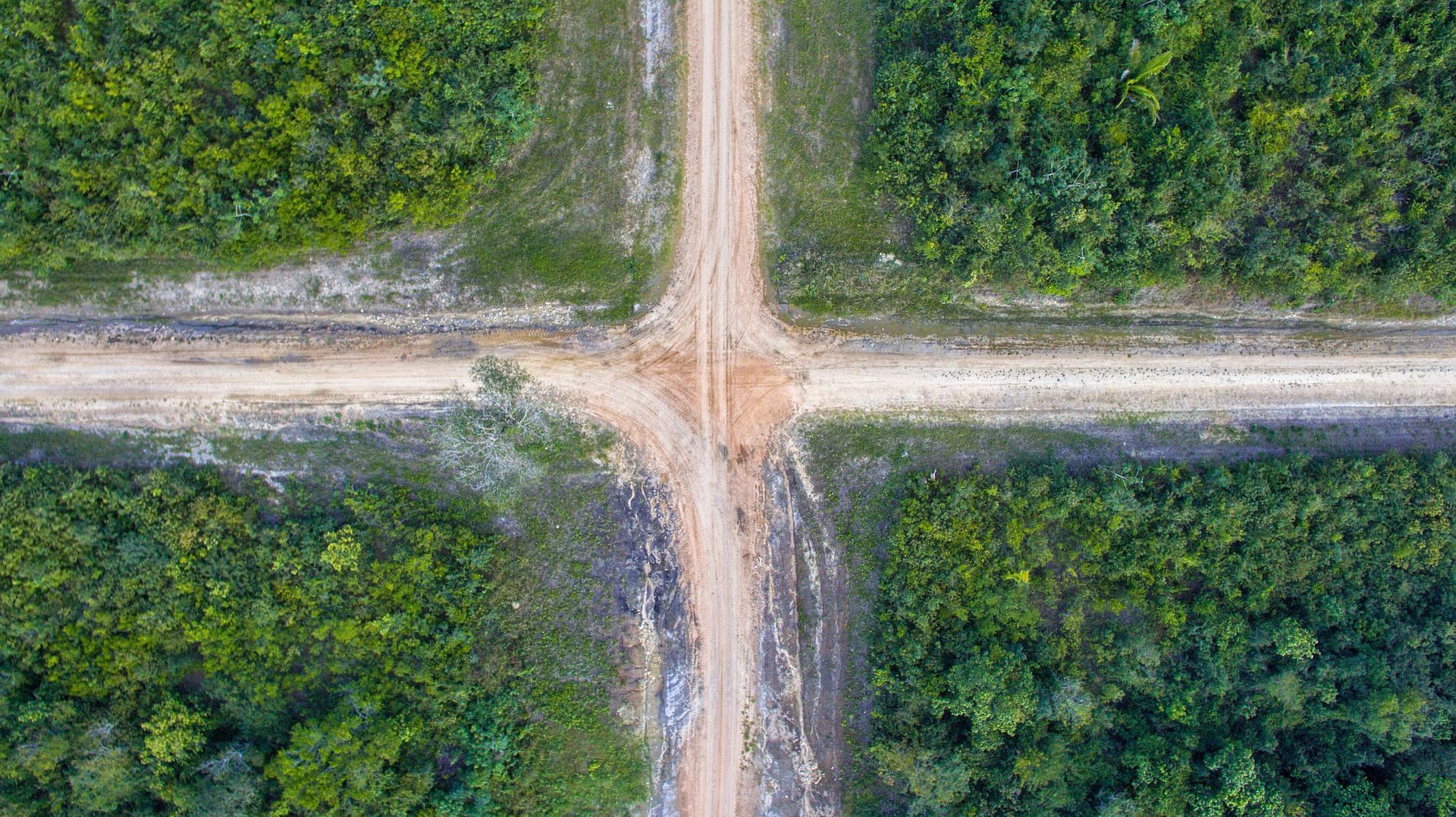
Questions lead me into metaphor. This one, a joining, two lines touching. Connecting at a perpendicular point to a become something–an intersection, a stopping point. A place for four directional choices, a crossroads. A letter used sparingly in the English language named “x.” A shape called cross as in stich, bar, or the leftover symbol of torture and murder attempted on God by humans.
Yet if the two lines have depth, like that of two felled trees, they double at the point of connection. If hollow out, this crossing place forms a pit. The pit, as in the space we all visit, even stay for a length of time, perhaps are still living in. It’s the point we occupy in the afterwards of traumatic experiences. Full of wounds, suffering, despair, and shock.
Pit forms a container for what has happened to us. Holds us until shock subsides. Enough for us to make choices: Either allow traumatic experiences to govern us by choosing to stay in pit not healing. Spread the pain of our traumatic experiences onto ourselves and others. Or the choice to reveal our truth, begin healing, do the work.
The choice to heal reminds me that God’s death on this wood, either in belief or as allegory, was temporary. God rose again. Lived on earth for a time. Once again feeding, teaching, and healing. Before commissioning the disciples to continue the work of “doing likewise.” Assured of and accompanied by God’s ongoing presence through God’s Spirit. Never alone as how it felt during the three days.
Another Memory
One morning, early in our relationship, Tony walked me to my car. The Chicago intersection at Glenwood and Berwyn was under construction. Each day a larger, messier, muddier hole deepened at the center of these crossing streets. We wondered again and again what this work meant? Was the city working on the sewer lines? Or something else? No one seemed to know so we watched, waited. Until one morning we walked out to a new sight. The back end of a car stuck straight up and out while the front end dove deep into the hole like a duck fishing in a pond. We groaned knowing we too had come close to driving into this new pit. Laughed as we imagined the driver opening the door, wondering how to jump down.
By evening the car was gone but we continued talking about the car in the hole outside our door. About a week later workers filled in this pit with a mound of rich black dirt. Then they planted a tree, some bushes, and flowers. The messiness of the pit reformed becoming both a place of beauty and growth as well as a reminder for drivers to slow down, keep safe, keep others safe.
Choice shapes our lives. The choice to heal forms in us in compassion for self toward a new direction. Healing helps us leave the pit knowing it has done its work. Gives us the inner strength and courage to roll our own stones away. Step out of God’s three days with the dead into life afterwards. In the choice to heal we enter new life for ourselves, others, and all of creation.
Accompanied by God’s Spirit. Amen.
Crossroads image by Ely Penner from Pixabay


 Jennifer Ohman-Rodriguez